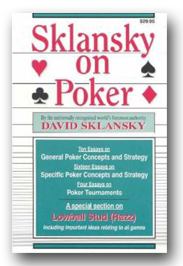
 Sklansky on Poker has not aged well. This isn’t to say that any of its content has been proven wrong, only that more recent publications and the resurgent popularity of big bet games have rendered much of the material irrelevant.
The section “Sklansky on Razz” is certainly the best material on that game in print, but it’s a game that’s rarely spread anymore. As for the other essays, they were even at the time of publication little more than Theory of Poker simplified and explained for beginners. The examples and many of the concepts are specific to fixed limit games, and some even more restricted to obsolete games like jacks-or-better five card draw.
More recent publications, some authored by Sklansky himself, cover this material in greater depth and nuance. Tournament Poker for Advanced Players, for instance, subsumes the tournament essays in this manual. And numerous books targeted to beginners in Hold ‘Em or other games, not to mention Theory of Poker, introduce concepts like pot odds, implied odds, expectation, and semi-bluffing more clearly, in greater detail, and with more relevant examples.
These essays would be of little interest to most serious players anyway. This isn’t to say that even experts always get them right, but they at least understand the concepts in theory, which is all that Sklansky’s very short essays address. Only beginners would find this material new or helpful, and many better books are now available to them.
The exception to all of this is the second half of the book, “Sklansky on Razz”. This is Sklansky at his best and is well worth the cost of the book to anyone who wants to succeed in this deceptively simple game.
Razz is a game well suited to Sklansky’s particular talent for identifying counter-intuitive but mathematically sound plays. Since there is only one kind of hand a player can make, deception and hand-reading are less important than in other forms of poker and “many general principles and concepts of poker can best be illustrated via the game of razz.”
Sklansky goes on to use the game to illustrate some nuances of pot odds, higher level thinking, relative position, range mixing, inducing mistakes, and ante stealing/defense. He doesn’t always draw the connection in so many words, but reading Sklansky’s thoughts on razz should help astute players better employ these concepts in any game.
For razz players, he also demonstrates some little known facts about the game. On fifth street, for instance, a four-card six is often a favorite over a rough made nine. And on third street, depending on which cards are dead, 8-6-4 can be a favorite over 3-2-A. Recognizing these situations better than one’s opponents can be very valuable, as they may happily but mistakenly cap the betting thinking they have the best of it.
It is this razz material that makes Sklansky on Poker potentially of interest to today’s poker player. The information from most of the other essays can be better gleaned from Theory of Poker, Tournament Poker for Advanced Players, and the better beginner’s books on the market.