Episode 445: Jonathan “Apestyles” Van Fleet
Jonathan Van Fleet

Podcast: Play in new window | Download
Carlos Welch is over live poker. He’s currently teaching special education in Portland and grinding mid-stakes MTTs on Ignition. In addition to his recent exploits, he and Andrew discuss tells and bluff-catching.
Timestamps
0:30 Hello & Welcome
42:21 Strategy
Links
Thanks for all the comments on What’s Your Play? Facing an Overbet on River.
Time for Some Game Theory
It’s probably impossible to find a game theoretically optimal betting strategy for me on the flop, and likewise a calling strategy for Villain, as there are more than two players … Read full post
Thanks to everyone who participated in What’s Your Play? Flush With Redraw.
I folded, and I don’t think it’s close. The short explanation is #TheyAlwaysHaveIt. Here’s a longer one:
Is This a Bluff-Catcher?
The first question to ask is whether Villain could be raising worse for value. If yes, … Read full post
Podcast: Play in new window | Download
The WSOP is obviously a busy time, so we just recorded a quick conversation this week, covering some general stuff about the World Series of Poker and a few of the first events/hands Andrew played. Please note that this was recorded before … Read full post
My latest poker strategy article for Two Plus Two Magazine, Poker is Not a Chest Beating Contest, addresses one of my favorite subjects, which is language and how it shapes the way we think:
“Poker lingo is full of bluster and bravado. For some, the colorful language and the … Read full post
Podcast: Play in new window | Download
Cate Hall, a former classmate of Vanessa Selbst’s at Yale Law School, walked away from a promising legal career to seek her fortune – and more importantly her happiness – in the poker world. With two final tables and five cashes on … Read full post
Depending on your definition of exciting, you might be interested to hear that my latest book has hit the digital shelves! The fifth volume of The Thinking Poker Diaries chronicles my 87th place finish the 2010 WSOP Main Event. Day by day, it introduces the situations and opponents I encountered … Read full post
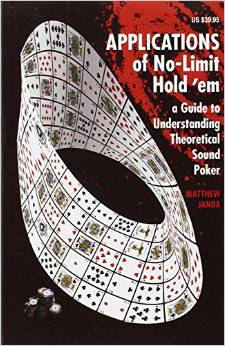 I recently finished reading Matthew Janda’s Applications of No-Limit Hold ‘Em and considered it one of the most helpful poker books I’ve read in some time. On a scale of 1 – 10, I give it a 9.5.
Applications is a Two Plus Two book par excellence. It’s dense, it’s … Read full post
Thanks to everyone who commented on this week’s What’s Your Play? Here’s a sample:
Ruud says, “Generally I find Villain has the goods when he bombs the river like this.”
Pepito agrees, “unless he contemptuously views you as a bad, nitty player, what adept villain expects Kx to fold given … Read full post
Thanks for all the comments on What’s Your Play? KJo in the BB. I think my favorite was Carlos’ remark that, “The goal in this hand is not to go after the fish. It is to go after the shark who is going after the fish. He has made himself … Read full post
I’ve got two new poker strategy articles to share with you. The first is the conclusion of my analysis of the infamous Mark Newhouse bustout hand from the 2014 WSOP Main Event (the first part of the article is here):
… Read full post“[T]his looks like a textbook example of a “leveling

This post is inspired by a question from the Tournament Poker Edge forums. I’m just going to paraphrase it here.
Q: In your videos, you very frequently call raises from the big blind with weak hands. You say that with antes in play you are getting odds, and that you … Read full post
Sorry for the delay on this week’s podcast. We do still have an episode in the works. In the meanwhile, here’s a hand submitted by listener favorite Carlos Welch in which he bluffs frequent commenter Pie Farmer. My comments at the end:
Q: This is a hand from our regular … Read full post
There were a lot of interesting hands from this, more than I have time to post here (keep an eye out, though, TPE members!). This was probably the most critical. Thanks to more than a bit of good luck, I’d run up quite a stack, good at my high point … Read full post
Podcast: Play in new window | Download
Kristy Arnett recently announced that she is stepping down from her long-time role as a producer, host, and writer for PokerNews. We talk to her about her career as well as her goals for the future, which include playing more poker, … Read full post
I posted this a few weeks ago but accidentally backdated it to appear as though it were posted on January 1. I think that as a result a lot of people never saw it. Apologies to those for whom it is old hat, and thanks to Matt Glassman for bringing … Read full post
 Thanks to those who commented on this week’s “What’s Your Play?”. I think this may have been the liveliest discussion yet, and I’d encourage everyone who hasn’t to read those comments, because I think those conversations are at least as valuable as what I’m going to say here.
I’ll … Read full post
Podcast: Play in new window | Download
Lee Jones joins us on the show to talk about the past, present, and future of poker and PokerStars. Lee’s an interesting guy with an interesting story, and his PokerStars blog is pretty interesting too. You can learn more about the Rec.Gambling.Poker … Read full post
Last weekend I played at the Aria poker room for the first time. I used to enjoy playing at the Venetian, but for a variety of reasons, not least Sheldon Adelson’s opposition to online poker, I was looking for a new favorite room. Aria seemed to be the place … Read full post
Q: While reading Sylvain’s discussion of his hands with Bonomo, I wondered how best to handle such an aggressive player. Sylvain described his style of pushing back against the aggro. I wondered if you can ever counter aggression with passive play, such as calling multiple streets. Then, near the … Read full post
Thanks to everyone who commented on What’s Your Plan? Boated Up in a Blind Battle. The most recent comment is also the one that most closely resembles my own opinions, so I’m going to start with what Rant2112 said:
… Read full post“Most of Villain’s range on the turn consists of bluff
The exciting (?) conclusion of my 2012 PCA Trip Report has just been published in the February issue of 2+2 Magazine. Regular readers of “What’s Your Play?” will recognize a few of the hands, but there’s plenty of new content for everyone, plus it turns out the Mizrachis’ mother … Read full post
Thanks again for all the great comments on this week’s What’s Your Plan?. I was a little worried since the question was more open-ended than usual, but once again we had a lot of really though-provoking contributions. I actually write about this hand in some detail in the new … Read full post
Sorry for the recent lack of posts; it’s been a busy week. I don’t have a lot to say about this one, it’s just a fun hand that I played today:
PokerStars No-Limit Hold’em, $6.00 BB (6 handed) – PokerStars Converter Tool from FlopTurnRiver.com
BB ($618)
UTG ($884.80)
Hero (MP) … Read full post
PokerStars No-Limit Hold’em, $4.00 BB (2 handed) – PokerStars Converter Tool from FlopTurnRiver.com
BB ($819.50)
Hero (SB) ($1000)
Preflop: Hero is SB with 6♥, J♣
Hero bets $9.60, BB calls $5.60
Flop: ($20.80) 2♠, 5♣, 5♦ (2 players)
BB checks, Hero checks
Turn: ($20.80) K♦ (2 … Read full post
We had an interesting discussion in last week’s Extracting Value seminar about slowplaying on wet boards (i.e. when there are a fair number of draws possible). It’s overall not a great idea, but I do advocate doing it with often with top set. Good hand readers don’t expect you to … Read full post
Whenever we get a lot of new visitors at Thinking Poker, and probably a lot of people who haven’t read my more monolithic trip reports (understandable), I reprint select stories that are buried in much longer narratives but that I consider among my best. This article is part of that … Read full post
My latest poker strategy article, Out of Position Against a LAG, has just been published in the March 2011 issue of 2+2 Magazine. It’s a street-by-street analysis of a single hand, highlighting a lesson that can be learned from each. Here’s an example:
Lesson: Against an opponent who is … Read full post
This hand is a good example of being aware of your own range and what your hand will look like to Villain. I had recently folded to a triple barrel from this same Villain, who generally exhibits very aggressive tendencies. I had no idea whether that history would make him … Read full post
 The first video in my new four-part series about HUD-based decision making and using statistics to exploit opponents has just gone live at Poker Savvy Plus. In conjunction with that, I’ve got a twist on the old “What’s Your Play?” series. In this hand, calling or folding are your … Read full post
Villain is a pretty good regular. He also plays higher and is well above average for the stakes. We’ve tangled a fair bit in the recent past and have some aggressive history. I believe his turn raising range to be disproportionately semi-bluffs, possibly with as little as a gutshot but … Read full post
My latest poker strategy article, Bluff Catching, is now appearing in the June issue of the 2+2 Internet Magazine. Here’s the hypothetical that kicks off the discussion:
… Read full postI had a nightmare last night that I was playing high-stakes heads up no-limit hold ’em with Phil Ivey himself. I
…because sometimes, you aren’t bluffing:
Full Tilt No-Limit Hold’em, $20.00 BB (2 handed) – Full-Tilt Converter Tool from FlopTurnRiver.com
BB ($14268.50)
Hero (SB) ($4179.50)
Preflop: Hero is SB with 7 , Q
, Q
Hero bets $60, BB calls $40
Flop: ($120) K, J , J
, J (2 players)… Read full post
This isn’t going to work against a lot of opponents, but against very tough opponents, it’s essential:
Full Tilt No-Limit Hold’em, $20.00 BB (6 handed) – Full-Tilt Converter Tool from FlopTurnRiver.com
Hero (MP) ($4429.50)
CO ($7120)
Button ($2587)
SB ($4449.30)
BB ($4169)
UTG ($712.40)
Preflop: Hero is MP with … Read full post
I recently made another appearance on Cardplayer’s “Run It Twice” feature, discussing a hand that regular blog readers will recognize:
“I just don’t think he’s telling a consistent story on the turn and the river. On the river, now, all of a sudden he wants me to believe … Read full post
This hand from the 2+2 high-stakes multi-table tournament forum got me thinking about what it means to be “at the top” of a polarized range. Here’s a quick summary, for those who can’t/won’t follow the link:
It’s a tournament, and blinds are 100/200. Hero raises to 475 UTG with KK, … Read full post
Full Tilt No-Limit Hold’em, $10.00 BB (6 handed) – Full-Tilt Converter Tool from FlopTurnRiver.com
UTG ($1027)
MP ($980)
CO ($1442.40)
Hero (Button) ($1471.25)
SB ($1000)
BB ($1336)
Preflop: Hero is Button with J, J
UTG bets $35, MP calls $35, CO calls $35, Hero raises to $165… Read full post