Posts Tagged ‘race’
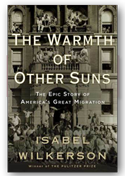
Suggested Read: The Warmth of Other Suns
Isabel Wilkerson’s The Warmth of Other Suns ought to be required reading for all Americans, black or otherwise. It tells a story that most of us know tangentially but whose true scale and historical importance are appreciated by few. I should say that I haven’t quite finished it yet (it’s a thick one), but today being Martin Luther King Day, it seemed an appropriate time to post a review.
In the early to mid- twentieth century, millions of African-Americans departed the deep South, where many still worked as sharecroppers on the same plantations on which their ancestors slaved, to seek a better life in the metropolises of the North. The resulting demographic shifts were seismic: the black population in states like Mississippi and South Carolina decreased by more than a third, while that of Northern cities like Chicago and Detroit increased ten-fold in the space of a few decades. They sought better wages, equitable treatment, and the freedom to live and work where they pleased. What they found was a new set of hardships that, cold as their reception was, usually represented an improvement over the lynchings and Jim Crow culture of the South.
None of this is ground-breaking stuff, but it was always something that I vaguely knew without ever thinking much about. “The Great Migration” was never on the curriculum of any US history class I ever took… Read the full review.
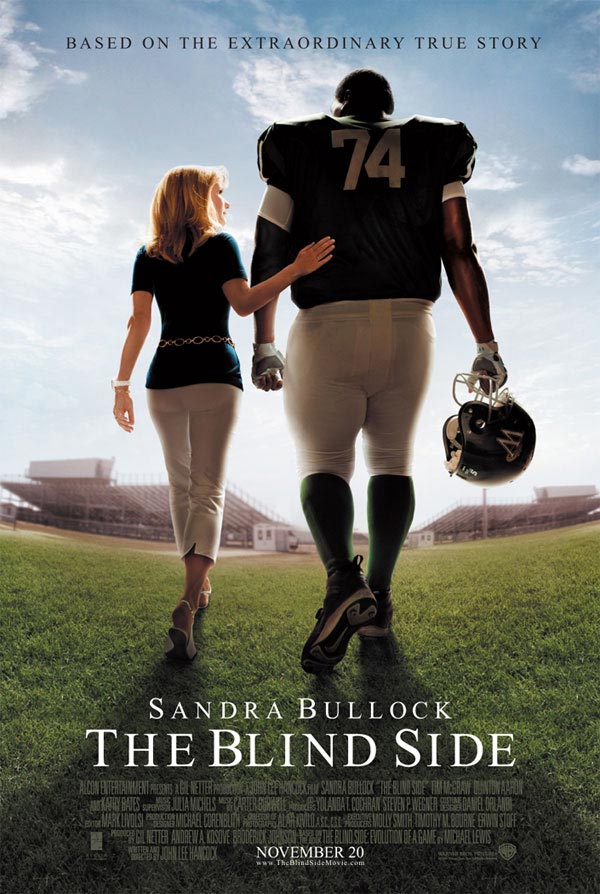
The Racial Politics of The Blind Side
I’ve been vaguely aware of both the plot of The Blind Side (homeless black teenager from broken family is adopted by wealthy white family and goes on to play pro football) and the critiques of its racial politics for some time, and despite its unexpected box office success, I’ve had little desire to see it. I’m currently in Florida visiting my grandmother, though, and she wanted to see The Blind Side, so see The Blind Side we did.
I don’t much care for Sandra Bullock, but she’s exactly as good as everyone says she is as the loving, no-nonsense matriarch of a wealthy Southern family. And the movie in general is pretty much what you’d expect: cutesy, saccharine, uplifting, and formulaic. It’s good for what it is though, with a remarkable story, quick pace, witty dialogue, and genuinely likable characters.
As for the film’s racial politics, I can’t say that I entirely agree with most of the critiques I’ve seen, though I do have a few of my own. A. O. Scott’s review for the New York Times encapsulates the most common criticism of Blind Side:
To the extent that Michael represents a social problem (or maybe a whole bunch of them, including poverty, drug addiction and family dysfunction), the solution depicted is individual, charitable and, at least implicitly, faith based.
Brown v Board Monument
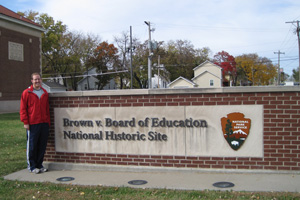
Driving through Topeka this morning, we stopped at the Brown v. Board of Education National Historic Landmark. Unlike the iconic Central High School in Little Rock, which we visited on a previous road trip, the physical location of the Brown landmark was not particularly significant. It was simply on the first floor of what was once an all-black elementary school that the eponymous plaintiff’s daughter was required to attend.
An aggressively friendly, if defensive and apologist, ranger explained that the all-black schools in mid-twentieth century Topeka actually provided an education on par with, if not superior to, that available at the all-white schools. I’m a little skeptical of that claim, for obvious reasons, but he did cite the fact that the black teachers were on the whole more highly educated than their white counterparts.
Apparently this was part of the reason that Topeka was chosen as one of the five cities in which the NAACP challenged segregation laws. Because there wasn’t a material inequality argument to be made (the NAACP’s own lawyers determined as much), Topeka enabled them to focus their suit on the very principle of separate schools, even when a seemingly equal education was available, which of course in many places it was not.
Gates at the Top of the Range
By now, you’ve probably all heard about the arrest of prominent black academic Henry Louis Gates, Jr. in his home by a Cambridge police officer. If you haven’t, or even if you have, I suggest reading the police report. The short version is that a neighbor called the police after witnessing Gates and his driver attempting to force open the front door of Gates’ home, which was apparently jammed. A police officer responded to a possible break-in, and, seeing Gates, demanded that he step outside. Gates refused, saying something to the effect of, “This is what happens to black men in America.” Some more bluster followed from both sides, and eventually Gates explained the situation but was arrested anyway for disorderly conduct.
Naturally, Gates and the officer tell slightly different stories, but the general consensus seems to be that both overreacted. Gates, understandably upset by being accused of breaking into his own home, called the officer a racist and, to some extent, refused to cooperate. In all likelihood, simply stepping outside and explaining the situation would have prevented any escalation.
The officer could have ignored the comments and left after identifying Gates as the legitimate occupant of the home. Instead, he chose to escalate the situation by arresting him for “disorderly conduct”
Get Your "The Wire" Fix
It’s been more than a year since the finale of The Wire, and I don’t know about you, but I’m missing the hell out of it. Consequently, I was very excited to see the Freakonomics Blog report that writer/creator David Simon is planning to shoot a pilot for HBO about New Orleans. Simon’s a native Baltimoron, so it’s unlikely he’ll be able to capture the spirit of another city quite so well, but I could still see him doing a bang-up job.
In the meantime, I’ve got a few suggestions to help you get your Wire fix:
1. Homicide: Life on the Street- Simon created but mostly did not write the critically-acclaimed NBC series. It’s a far more traditional crime drama than The Wire, but especially in it’s early seasons it epitomizes the best possibilities of the genre to explore psychology, philosophy, and sociology. Homicide‘s fantastic cast includes several faces that will be familiar from The Wire. Clayton LeBouef who plays strip club owner and wannabe drug dealer Orlando on The Wire but villainous police Colonel Barnfather on Homicide. McNulty’s ex-wife, played by Callie Thorne, appears as one of the lead detectives in Homicide’s later seasons. Most significantly, Clark Johnson, one of Homicide‘s stars from the very beginning, appears in season 5 of The Wire as Sun paper editor Gus Haynes. Also be on the lookout for guest appearances by Robin Williams, Chris Rock, John Waters, and many more!
America’s Black Precedent
I wrote this yesterday, about 12 hours after McCain’s concession, but didn’t get a chance to post it until today.
I can’t bring myself to get as excited as I feel I should be about Obama’s victory. I was pulling for him- he was in fact the first major party candidate for whom I voted in a presidential election- but neither his victory nor the historic election of America’s first black president excites me the way they have others.
It’s nothing personal about Obama. He seems to be a smart and capable candidate and who may well prove a good president. But I just can’t imagine him deserving or living up to the incredible expectations that seem to be invested in him.
His victory is being celebrated as a mandate for change, a watershed moment for liberalism in America, and a civil rights milestone. I believe it is all of these things, but not to the extent so many people seem to think.
Not in the case of the latter two, anyway. With regard to the mandate for change, I think that expectations are hopelessly high. Much was made, in the days before the election, of the hope that voters, particularly black ones, had invested in Obama. There was talk of unprecedented engagement with the political process among African-Americans and speculation about the sense of disenfranchisement that might ensue if Obama were somehow to lose.
Central High School, Little Rock, Arkansas
A few days ago, as part of our cross-country road trip, Emily and I spend the better part of a day in Little Rock, Arkansas. I found it to be quite an interesting place, kind of a hip and relatively liberal mecca in a region of the US often stereotyped as backwards and conservative. Presumably Bill Clinton’s legacy and influence have something to do with this, but I imagine the man was equally a product of the place.
After setting up our tent, our first stop was a scenic overlook at a nearby state park. As we were doing our best to point a camera at ourselves blindly with one hand, another couple arrived and offered to take our picture. They were a ‘classic’ Arkansas couple: he a straggly white guy sporting a goatee and a Home Depot polo, she a slender black woman with a pronounced posterior, and both exceedingly friendly and polite.
The man asked where we were from, and after I gave him a brief synopsis, I asked if they lived around here. He positively swelled with pride and drawled, “Why, yes sir, we do!”
“You’re lucky,” I told him, nodding at the sprawling, tree-covered delta spread out below us. They both smiled and offered some suggestions of things to see in the area, most notably the Big Dam Bridge.
LA Gangs
I happened today to come across two media pieces dealing, at least tangentially, with the issue of gangs in Los Angeles. Gangs and related problems of crime and drugs are issues in virtually every major metropolitan area in the US, but LA seems to be the epicenter both in terms of incidence and as a barometer of how the country generally addresses the issue.
I’ll start with the good news. My friend David Wiltz is garnering still more media attention for the work that he has done with youth in LA. He and one of his former debaters were interviewed in this National Public Radio segment.
There are nearly two dozen urban debate leagues in the US, and I’m more familiar with some than with others, but everything I’ve seen suggests that few leagues do as good a job as LA has done to reach young people already in gangs or at high risk of getting involved with one. To some extent, this is simply a matter of necessity. Gangs are such an omnipresent part of urban life in LA that it would be nearly impossible to work with the populations Dave does without addressing the issue.