
Episode 390: Rapid Fire Strategy
Carlos and Andrew give rapid fire (by Thinking Poker standards) answers to questions from the Thinking Poker Daily patreon.
Strategy links -

 Thanks for all the comments on this week’s What’s Your Play? In this post I’m going to talk a lot about a concept that I call Value Targeting. Hopefully it will make sense just from what I say here, but if you want to learn more about it, you can … Read full post
I suppose the Atlantis resort is an appropriate place for a poker tournament, because the whole place is built on value betting the shit out of rich fish. Everywhere the trappings of luxury convince people to fork over absurd sums of money for silly baubles, bad food, and tacky experiences.… Read full post
My latest poker strategy article, “A Different Kind of Slowplaying“, is now appearing in Cardplayer. Here’s a little taste of what you’ll find there:
Particularly in big-bet games like no-limit hold‘em and pot-limit Omaha, failing to build the pot and missing out on a bet are potentially very … Read full post
 Villain is an unknown who seems to play reasonably well. No idea what if anything he knows about Hero (me), but I did have my PokerStars Team Online red spade at the time this hand was played.
For those who have difficulty seeing suits, they’re not terribly relevant here. Hero’s … Read full post
 Q: My understanding is that I should generally continuation bet a polarized range consisting of both bluffs and strong hands but check medium-strength hands for pot control. Sometimes I have difficulty determining which category my hand falls into. For example, if I raise in middle position, the BB calls, and … Read full post
My latest poker strategy article, Balance, addresses a pet peeve of mine that I see often in the tournament forums:
… Read full postBalance is one of the most misunderstood concepts in tournament poker. Many players believe that playing in a balanced way matters only when dealing with players they encounter on
My latest poker strategy article, What Are You Afraid Of?, is now appearing in the July 2011 edition of the 2+2 Magazine. The article uses a single hand to look at a larger point about game theory and exploitability:
… Read full postBeing “underrepresented” or “too weak” are not bad things in
Someone e-mailed me this question recently, and as I began to compose an answer, it occurred to me that it could make for an interesting blog post:
… Read full postRecently a friend of mine and I were batting around a question about the pros.
Essentially it came down to this:
“Do pros
Edit: Made a mistake in the original post. Villain did not have two pair, he had Aces with a kicker that didn’t play.
$5/$10 NLHE, $1100 effective stacks. Action folds to a decent TAG regular in the SB, he opens to $30, I make it $90 with AJo, he makes … Read full post
This hand from the 2+2 high-stakes multi-table tournament forum got me thinking about what it means to be “at the top” of a polarized range. Here’s a quick summary, for those who can’t/won’t follow the link:
It’s a tournament, and blinds are 100/200. Hero raises to 475 UTG with KK, … Read full post
Full Tilt No-Limit Hold’em, $10.00 BB (6 handed) – Full-Tilt Converter Tool from FlopTurnRiver.com
UTG ($1027)
MP ($980)
CO ($1442.40)
Hero (Button) ($1471.25)
SB ($1000)
BB ($1336)
Preflop: Hero is Button with J , J
, J
UTG bets $35, MP calls $35, CO calls $35, Hero raises to $165… Read full post
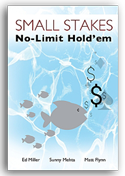 Small Stakes No-Limit Hold ’em
by Ed Miller, Sunny Mehta, and Matt Flynn
Professional No Limit Hold ‘Em, Volume 1 (PNLHE) is one of my all-time favorite poker books and the one that I recommend to anyone looking to get started to the game. I eagerly awaited the … Read full post
One of my students asked me about this hand today, and I thought it was pretty interesting. My first instinct was that the check-raise was thin but good. Q8 is pretty much the top of Hero’s range here, and this looks like such a weird line that I doubt Villain … Read full post