Archive for October, 2009

Halloween Stories

I overheard a pretty funny conversation today that reminded me of another funny Halloween incident from some years ago.

A Critical Difference

The child in this story is roughly 9 years old.

Father: How was your Halloween party today at school.

Son: Ummm, this girl Matilda, it looked like she was wearing a sign that said “Hitler.”

Father: Oh. Geez.

Son: Yeah, it turned out it just said “Highlighter” though.

Father: You don’t want to get those two confused.

The Priest

It’s been probably 12-15 years since I witnessed this one, but I still remember it vividly. The child, about 6 years old, is in a Party City with his mother, presumably shopping for a costume.

Son: Picks up a huge plastic scythe with a blood-covered blade nearly as long as he is tall, and holds it up for his mother to see. Mommy, mommy, I want to be a priest.

Mother: What kinda fucked up priest you talkin’ bout?


The Old School: Oswald Jacoby on Poker

I like old poker books. It’s fun to see how people played, and talked about, the game decades ago. In “The Old School”, I share the best and worst from these antiquated tomes. Sometimes the strategy is laughable, sometimes it is surprisingly astute, but it always provides a unique insight into the history of poker.

Oswald Jacoby was a world-renowned bridge author and player who published 17 books and over 10,000 articles on that and other card games. In Oswald Jacoby on Poker, he turned his considerable card skill to “The Great American Game”.

Originally published in 1940, the book discusses primarily Draw and 5-Card Stud, with some attention paid to 7-Card Stud and to variations of these games. There is no mention of Texas Hold ‘Em, and only the briefest mention of any sort of community card game: Cincinnati, in which players have five cards of their own and five community cards from which to make a five-card hand.

There is also no mention of casinos or professional card rooms of any kind. It seems the intended audience are those playing in friendly games with family, co-workers, or fellow soldiers. Indeed, Jacoby explains how to set the stakes for various games so that they do not prove too high for anyone involved and proposes some means of compensating the biggest losers in any given session.

Even on the River, Your Bluffing Range Matters

…because sometimes, you aren’t bluffing:

Full Tilt No-Limit Hold’em, $20.00 BB (2 handed) – Full-Tilt Converter Tool from FlopTurnRiver.com

BB ($14268.50)
Hero (SB) ($4179.50)

Preflop: Hero is SB with 7, Q
Hero bets $60, BB calls $40

Flop: ($120) K, J, J (2 players)
BB checks, Hero bets $77, BB calls $77

Turn: ($274) 8 (2 players)
BB checks, Hero checks

River: ($274) 2 (2 players)
BB bets $210, Hero calls $210

Total pot: $694 | Rake: $0.50

Results:
Hero had 7, Q (one pair, Jacks).
BB had Q, 9 (one pair, Jacks).
Outcome: BB won $693.50

Although I didn’t recognize his name, this guy played very well, and it didn’t take me long to quit him. He’d been making a lot of good, thin value check-raises on dry flops like this, and he very rarely folded them. Thus, I thought his flop call represented either very marginal showdown value or a float with the intention of bluffing the river. Turns out it was both, which is really as it should be. I think he doesn’t turn Ax into a bluff on the river, which is why I call with Q-high, but I think this is exactly the right way for him to play Q9.

Brown v Board Monument

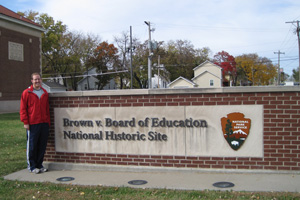
andrewatbrown2Driving through Topeka this morning, we stopped at the Brown v. Board of Education National Historic Landmark. Unlike the iconic Central High School in Little Rock, which we visited on a previous road trip, the physical location of the Brown landmark was not particularly significant. It was simply on the first floor of what was once an all-black elementary school that the eponymous plaintiff’s daughter was required to attend.

An aggressively friendly, if defensive and apologist, ranger explained that the all-black schools in mid-twentieth century Topeka actually provided an education on par with, if not superior to, that available at the all-white schools. I’m a little skeptical of that claim, for obvious reasons, but he did cite the fact that the black teachers were on the whole more highly educated than their white counterparts.

Apparently this was part of the reason that Topeka was chosen as one of the five cities in which the NAACP challenged segregation laws. Because there wasn’t a material inequality argument to be made (the NAACP’s own lawyers determined as much), Topeka enabled them to focus their suit on the very principle of separate schools, even when a seemingly equal education was available, which of course in many places it was not.

Advanced Bluff Induction

This isn’t going to work against a lot of opponents, but against very tough opponents, it’s essential:
Full Tilt No-Limit Hold’em, $20.00 BB (6 handed) – Full-Tilt Converter Tool from FlopTurnRiver.com

Hero (MP) ($4429.50)
CO ($7120)
Button ($2587)
SB ($4449.30)
BB ($4169)
UTG ($712.40)

Preflop: Hero is MP with 4, 4
UTG calls $20, Hero bets $90, 1 fold, Button calls $90, 2 folds, UTG calls $70

Flop: ($300) 3, 4, 6 (3 players)
UTG checks, Hero bets $187, Button calls $187, 1 fold

Turn: ($674) J (2 players)
Hero bets $444, Button calls $444

River: ($1562) Q (2 players)
Hero checks, Button bets $1225, Hero calls $1225

Total pot: $4012 | Rake: $3

Results:
Button had 6, 7 (one pair, sixes).
Hero had 4, 4 (three of a kind, fours).
Outcome: Hero won $4009

This guy isn’t calling the turn with a bare draw, so I’m not too concerned about him having the flush. He could have a big draw, something like Ah5h, that he chose to “slowplay”, or maybe a flush with the Jh, but I don’t think he has a flush too often. His most likely hand is something marginal with showdown value, either a bare pair that was bluff catching or a pair plus draw.

The Flop Squeeze Play

$5/$10 NLHE 6-handed game. Villains have about $1000 each, I cover. MP opens to $35, BTN calls, I call 9h 7h in the BB.

Flop Ks 6h 2d. I check, MP bets $70 into $105 pot, BTN calls, I raise to $190, both fold. Why?

The logic here is very similar to the pre-flop squeeze play, particularly at the time that Harrington was writing his first book (ie before most people knew what a squeeze play was). The original better has a very wide range, and consequently so does the caller, especially since he didn’t 3-bet preflop. My raise into both of them represents strength in a spot where they don’t commonly see a bluff, not to mention that there is extra pressure on the original better since he still has someone left to act behind him.

I expect MP to fold unless he has a pair of K’s or better. While all of those hands are in his range, all he’s done so far is raise pre-flop (something this particular player did often) and then bet a pretty ideal flop. His range is plenty wide, and he probably folds 80% of the time or more.

Elaboration on Cryptic Advice

I posted an admittedly under-explained bit of advice last night. I was cryptic for a reason: if I’m too specific here, anyone who reads this blog could exploit the hell out of a very common spot. But here’s a pretty simple example that I don’t think is giving away too much:

Full Tilt No-Limit Hold’em, $10.00 BB (6 handed) – Full-Tilt Converter Tool from FlopTurnRiver.com

CO ($2404)
Button ($2311.25)
SB ($1025)
Hero (BB) ($2000)
UTG ($2976.45)
MP ($3368.50)

Preflop: Hero is BB with 7, 8
2 folds, CO bets $30, Button calls $30, 1 fold, Hero raises to $133, CO calls $103, Button calls $103

Flop: ($404) 10, 2, 2 (3 players)
Hero bets $277, CO calls $277, 1 fold

Turn: ($958) 6 (2 players)
Hero checks, CO bets $400, Hero raises to $1590 (All-In), CO calls $1190

River: ($4138) 4 (2 players, 1 all-in)

Total pot: $4138 | Rake: $3

Results:
Hero had 7, 8 (one pair, twos).
CO had K, K (two pair, Kings and twos).
Outcome: CO won $4135

I’m only using this as an example of a transparent turn bet. I’m definitely not holding this up as an example of a well-played hand on my part. Notice how Villain, holding the effective nuts, bets an uncommonly small amount, less than half the pot, in order to insure that I have room to check-raise him. Suppose Villain has the big draw instead- do you think he’d bet the same amount that he did with KK?

Quick Bit of Cryptic Advice

Most players handle the turn far worse than any other street. In particular, when the pot is getting large, even very good players tend to revert to level two thinking on the turn. They are making the play that they think is best given their hand versus your range, with little consideration for what they are representing. Pay attention to your opponent’s turn bet sizing, especially in large pots, and ask yourself, “What does it look like he’s trying to get me to do?” Then, do the opposite.

Note that this isn’t generic advice for all streets. Many players can get into complex leveling wars, so you can’t always just do the opposite of what it seems your opponent wants. But on the turn, in big pots, you usually can.